Monday, 22 April 2013

Sunday, 21 April 2013
Saturday, 20 April 2013
History of Soap Operas
History of Soap Operas
'Soap Opera' is a phone first coined in the 1930s in the USA. it was used to describe radio series that were sponsored by soap manufacturers.
Conventions of a Soap Opera:
- Usually runs week-in, week-out, all year round
- It features continuous narratives dealing with domestic themes and personal or family relationships
- Has a well-known theme tune
- Bigger casts- however there is a limit to the number of characters available at any one time.
- They're often set around a small, central area such as a square or village
- Features ordinary working class characters
- British soaps aim for realism and realistic plots
- They always end on cliffhangers
- 3,4 or even 5 story lines are in place at one time
Characters:
The grandparent figure- wise old person. usually female (This character helps others with their problems with advice and support)
The strong woman- An independent, powerful, aggressive woman. She's usually found at the centre of conflicts
Jack-the-lad- A male character that manipulates others to his own ends. 'The Baddie'.
Young Couple- A couple that bravely faces the difficulties of life.
Feisty Young Female- A strong-willed girl, almost always young, who desires independence. She's usually argumentative.
Troublesome oldie- Older, grumpy and meddling. Always interferes in other peoples business. This character is still loved for good intentions.
The boss figure- In charge, people can be scared of him, usually a male character.
Vladimir Propp and Narrative Theory (1895-1970)
Vladimir Propp and Narrative Theory (1895-1970)
Narrative is defined as the way a story is organised.
Propp was a Soviet Scholar who analysed Russian Folk Tales.
He found that there were basic components that make up a narrative.
Propp's 8 Key Characters:
1. The Hero- reacts to the donor, weds the princess.
2. The Villain- struggles against the hero.
3. The Donor- prepares the hero or gives the hero some magical object.
4. The Helper- helps the hero in their quest.
5. The Father Figure- an older, wise man offering comfort or guidance. A role model.
6. The Dispatcher- a character who makes the lack known and sends the hero off.
7. The Princess- the hero deserves her throughout the story but is unable to marry her because of an unfair evil, usually because of the villain.
8. False Hero- helps the hero and we think the false hero is the hero at the start but ends up not being the hero.
Propp's Narrative Functions:
-Preparation
-Complication
-Transference
-Struggle
-Return
-Recognition
Propp's Characters / Star Wars Characters
Hero / Luke Skywalker
Villain / Darth Vader
Donor / Obi-wan Kenobi
Helper / R2D2, C3PO, Chewbacca
Father Figure / Obi-wan Kenobi
Dispatcher / Princess Leia
Princess / Princess Leia
False Hero / Han Solo
Antonio Gramsci modified Marx's theory with the concept of hegemony. Hegemony are dominant groups that retain power not through physical force but through perpetuating particular attitudes and values which appear so 'obvious' that they are often described as 'common sense'.
These taken-for-granted values at the heart of a society become dominant by what appear to be natural processes rather than through any imposed system of authority.
The media could be seen to actively 'naturalise' or reinforce these values or ideology.
Characteristics
Characteristics
Men are seen as the following:
- Masculine
- Controlling
- Stoic
- Strong
- Possessive
- Power
- Confrontational
Whereas Woman are seen as the following:
- Feminine
- Emotional
- Innocent
- Honest
- Vulnerable
- Subordinate
- Narcissistic
- Promiscuous
- Home Maker
- Independent
- Weak
Archetypes can be universally understood and are well recognised in traditional stories. They are known as 'The Original Model'.
Generic Types: In relation to specific genres (crime, drama, period drama etc). Characters which offer a means of discussing contemporary society by using 'stock' characters. They are understood in relation to other media texts in the same genre, rather than referencing the 'real world' E.g. 'the gay best friend in a Rom Com' or 'the antagonistic henchman in an action film'.
Stereotype: Judging someone before you meet and judging certain people regardless of their personality. This can be determined from dress, speech and behaviour etc. The saying 'Don't judge a book by its cover' can be associated with stereotypes.
Representation
Representation
Key Word: Archetype= The Original Model
The media constructs meanings about the world.
They represent it and help audiences make sense of it.
There needs to be a shared recognition of people, situations and ideas for representation to be meaningful.
This prompts the question: how have groups been represented by media products? In a positive or negative way?
The media give us images, and ways of imagining particular groups which can have material effects on how these groups are understood by others.
Stereotypes represent people in society by emphasising certain common features.
Popular TV such as Soaps, dramas and sitcoms make extensive use of stereotypes so that the audience can quickly recognise certain types of characters.
They are identified through characteristics such as dress, speech and behaviour.
The stereotype therefore assists the dominant groups in maintaining their power over subordinate groups.
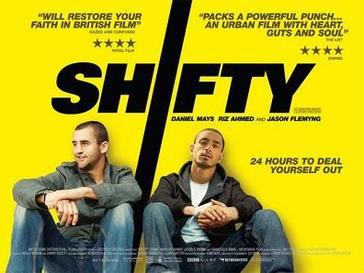
Shifty
Shifty
Shifty was made in 2008 under the Microwave Scheme.
It was made in 18 days and it cost less than £100,000 to make. This influenced other small film companies and film industries to do the same.
Evan Creevy wrote and directed the film.
It was released on the 24th April 2009.
It made £143,000 in box office.
It was distributed by Metrodome who marketed the film by spending £50,000 trying to market it in ways such as; posters and billboards etc.
Metrodome produced 2 different types of trailers. One for older people and One for younger people. This was so the could get younger people in the Cinemas to watch their film and to get them interested in the film.
Cross media convergence was used to promote Shifty.
They also used Fly-posters, adverts on Pirate Radio, the Internet and emails to promote the film. They also used websites and social networking sites.
Subscribe to:
Posts (Atom)