Sunday, 28 April 2013

Saturday, 27 April 2013
Friday, 26 April 2013
Thursday, 25 April 2013
Wednesday, 24 April 2013
Tuesday, 23 April 2013
Monday, 22 April 2013
Sunday, 21 April 2013
Saturday, 20 April 2013
History of Soap Operas
History of Soap Operas
'Soap Opera' is a phone first coined in the 1930s in the USA. it was used to describe radio series that were sponsored by soap manufacturers.
Conventions of a Soap Opera:
- Usually runs week-in, week-out, all year round
- It features continuous narratives dealing with domestic themes and personal or family relationships
- Has a well-known theme tune
- Bigger casts- however there is a limit to the number of characters available at any one time.
- They're often set around a small, central area such as a square or village
- Features ordinary working class characters
- British soaps aim for realism and realistic plots
- They always end on cliffhangers
- 3,4 or even 5 story lines are in place at one time
Characters:
The grandparent figure- wise old person. usually female (This character helps others with their problems with advice and support)
The strong woman- An independent, powerful, aggressive woman. She's usually found at the centre of conflicts
Jack-the-lad- A male character that manipulates others to his own ends. 'The Baddie'.
Young Couple- A couple that bravely faces the difficulties of life.
Feisty Young Female- A strong-willed girl, almost always young, who desires independence. She's usually argumentative.
Troublesome oldie- Older, grumpy and meddling. Always interferes in other peoples business. This character is still loved for good intentions.
The boss figure- In charge, people can be scared of him, usually a male character.
Vladimir Propp and Narrative Theory (1895-1970)
Vladimir Propp and Narrative Theory (1895-1970)
Narrative is defined as the way a story is organised.
Propp was a Soviet Scholar who analysed Russian Folk Tales.
He found that there were basic components that make up a narrative.
Propp's 8 Key Characters:
1. The Hero- reacts to the donor, weds the princess.
2. The Villain- struggles against the hero.
3. The Donor- prepares the hero or gives the hero some magical object.
4. The Helper- helps the hero in their quest.
5. The Father Figure- an older, wise man offering comfort or guidance. A role model.
6. The Dispatcher- a character who makes the lack known and sends the hero off.
7. The Princess- the hero deserves her throughout the story but is unable to marry her because of an unfair evil, usually because of the villain.
8. False Hero- helps the hero and we think the false hero is the hero at the start but ends up not being the hero.
Propp's Narrative Functions:
-Preparation
-Complication
-Transference
-Struggle
-Return
-Recognition
Propp's Characters / Star Wars Characters
Hero / Luke Skywalker
Villain / Darth Vader
Donor / Obi-wan Kenobi
Helper / R2D2, C3PO, Chewbacca
Father Figure / Obi-wan Kenobi
Dispatcher / Princess Leia
Princess / Princess Leia
False Hero / Han Solo
Antonio Gramsci modified Marx's theory with the concept of hegemony. Hegemony are dominant groups that retain power not through physical force but through perpetuating particular attitudes and values which appear so 'obvious' that they are often described as 'common sense'.
These taken-for-granted values at the heart of a society become dominant by what appear to be natural processes rather than through any imposed system of authority.
The media could be seen to actively 'naturalise' or reinforce these values or ideology.
Characteristics
Characteristics
Men are seen as the following:
- Masculine
- Controlling
- Stoic
- Strong
- Possessive
- Power
- Confrontational
Whereas Woman are seen as the following:
- Feminine
- Emotional
- Innocent
- Honest
- Vulnerable
- Subordinate
- Narcissistic
- Promiscuous
- Home Maker
- Independent
- Weak
Archetypes can be universally understood and are well recognised in traditional stories. They are known as 'The Original Model'.
Generic Types: In relation to specific genres (crime, drama, period drama etc). Characters which offer a means of discussing contemporary society by using 'stock' characters. They are understood in relation to other media texts in the same genre, rather than referencing the 'real world' E.g. 'the gay best friend in a Rom Com' or 'the antagonistic henchman in an action film'.
Stereotype: Judging someone before you meet and judging certain people regardless of their personality. This can be determined from dress, speech and behaviour etc. The saying 'Don't judge a book by its cover' can be associated with stereotypes.
Representation
Representation
Key Word: Archetype= The Original Model
The media constructs meanings about the world.
They represent it and help audiences make sense of it.
There needs to be a shared recognition of people, situations and ideas for representation to be meaningful.
This prompts the question: how have groups been represented by media products? In a positive or negative way?
The media give us images, and ways of imagining particular groups which can have material effects on how these groups are understood by others.
Stereotypes represent people in society by emphasising certain common features.
Popular TV such as Soaps, dramas and sitcoms make extensive use of stereotypes so that the audience can quickly recognise certain types of characters.
They are identified through characteristics such as dress, speech and behaviour.
The stereotype therefore assists the dominant groups in maintaining their power over subordinate groups.
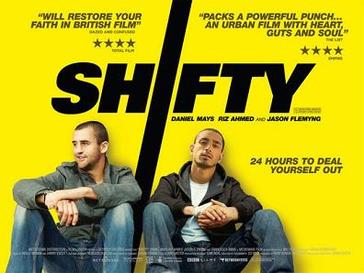
Shifty
Shifty
Shifty was made in 2008 under the Microwave Scheme.
It was made in 18 days and it cost less than £100,000 to make. This influenced other small film companies and film industries to do the same.
Evan Creevy wrote and directed the film.
It was released on the 24th April 2009.
It made £143,000 in box office.
It was distributed by Metrodome who marketed the film by spending £50,000 trying to market it in ways such as; posters and billboards etc.
Metrodome produced 2 different types of trailers. One for older people and One for younger people. This was so the could get younger people in the Cinemas to watch their film and to get them interested in the film.
Cross media convergence was used to promote Shifty.
They also used Fly-posters, adverts on Pirate Radio, the Internet and emails to promote the film. They also used websites and social networking sites.
The Hunger Games (case study)
The Hunger Games (case study)
Production details:
Director: Gary Ross
Producer: Nina Jacobson
Co-produced and Distributed by: LionsGate
Based on a BOOK!
On the opening day the film made $67.3 million
On the opening weekend the film made $152.5 million
It's the first film since Avatar to remain in first place at the American Box Office for 4 weekends running.
Movies Budget: $78 million
Grossing: $685 million
The film sold out in over 4,300 showings across the US
Tentpole releases are when the studios used for the film are kept going. e.g. The money made from The Hunger Games kept LionsGate going. And the money made from Twilight kept Summit Entertainment going.
Marketing Budget:
Bigger studios spend $100 million marketing major releases and have worldwide marketing and publicity staffs of over 100 people. Lionsgate has generated a high interest with only 21 people.
LionsGate used cross media convergence such as print to publish The Hunger Games.
The prints used were: 80,000 posters, ads, billboards etc to help publish The Hunger Games.
Twitter was the main marketing tactic used.
In July 2011 they released the first official poster via Facebook. And in August 2011 they gave out a sneak peak teaser trailer. All of these things build up to the exhibition of the film,, which creates popularity, anticipation and excitement.
"The Hunger Games" trended worldwide on Twitter within minutes.
Publicity Stunts (PR) were performed e.g. 5 fans were invited to the films' set, no reporters were allowed.

Digital Production
Digital Production
What is a non-digital film?
- Traditional films were made up image sprinted onto acetate negatives.
- These are then 'spliced' together to form a reel of film.
- These are then fed through a projector at a constant speed of 24 frames a second which makes the pictures appear to be moving, this is known as Analogue.
What are the advantages of digital production?
- Digital camcorders using a high-definition format called HD-CAM are much cheaper than standard film cameras.
- New digital camera technology rivals traditional film for quality.
- High quality film production is now far more accessible.
- Digital technology can store, transmit and retrieve a huge amount of data exactly as it was originally recorded.
- The quality of digital film doesn't deteriorate.
- Analogue technology (film) loses info in transmission and degrades every time you view it.
- Memory cards can be re-used many times, unlike film.
- Footage can be viewed immediately on set.
- Production time is cut and so are costs.
- By Hollywood standards digital video costs virtually nothing.
- Digital info is more flexible than Analogue info.
- A computer can manipulate bytes of data very easily.
- Virtually no processing necessary before the editing stage.
- E.g. ease of editing using a program such as Final Cut Express/ AVID/ Premiere.
- This saves time which saves money.
- E.g. Attack of the clones (Star Wars):
- first digital film
- $16,000 was made on 220 hours of digital tape
- $1.8 million would have been spent on 220 hours of film
A famous Director like, Quentine Tarantino refuses to film Digitally as he thinks it ruins the film because he prefers Analogue.
Digital Cinema- Distribution:
- Digital films are big computer files
- Can be written to DVD-Rom
- Sent via broadband
- Transmitted via satellite
- No shipping costs virtually
- Not more expensive to show in more than one cinema
What are the advantages to digital distribution?
- Film prints are very expensive (£1500 - £3000) per print
- Expensive to ship heavy reels of film and then to collect them when film finishes its run
- You have to be very cautious about where your films are played because of cost
- This is one reason why there is such a limited choice at multiplexes
- Digital films can be opened simultaneously all over the world
- When first introduced digital projectors were incredibly expensive and so the cost to cinemas were reluctant to buy them.
Digital Cinema- Exhibition:
- A good analogue film projector produces a clear, crisp, vibrant image but every time the print is projected the film is damaged
- A digital projector produces a high quality image and sound every time
- The 1000th view is as good as the first one
- A digital projector doesn't need a trained projectionist
MacGuffin
The MacGuffin is a plot element, that catches the audiences' attention or drives the plot of a work of fiction.
In the MacGuffin the major players in the story are willing to do and sacrifice almost anything to obtain it, regardless of what the MacGuffin actually is.
The MacGuffin can be ambiguous and it can be things like money or power.
The MacGuffin is often forgotten even though it is sometimes introduced at the start or at the end of the film.
In the MacGuffin the major players in the story are willing to do and sacrifice almost anything to obtain it, regardless of what the MacGuffin actually is.
The MacGuffin can be ambiguous and it can be things like money or power.
The MacGuffin is often forgotten even though it is sometimes introduced at the start or at the end of the film.
Thursday, 18 April 2013
Primeval Extract
In this
extract we find that peoples characteristics can differentiate from what
society expect from them because of their gender and other aspects. We can also
categorise people by using Propp’s narrative functions.
The blonde
woman in the extract carries out typical men jobs like holding a gun and
operating a JCB. Unlike the other brown haired woman being threatened by the
man with the dogs, the blonde haired woman is wearing outdoor clothing.
Therefore she instantly gives us the impression that she is not a typical woman
as she battles with a big sabre-tooth. Stereotypically society would think that
she don’t act like a typical woman, because in her situation, battling with a
sabre-tooth is something a woman would not do as, any other woman would scream
and cower away. According to Propp’s narrative characters this woman could be the
false hero as at the start she tries and saves the man she’s with and it makes
the audience think she is the hero, but it’s possible she could be the
princess/damsel in distress also as she is saved by the man she’s with.
The man
running away and distracting the sabre-tooth creature is wearing outdoor men
clothing which is typical of a man. At the start of the extract he carried
wood, this is a job that a man would do. He also shouts at the creature and
battles with it, this is manly behaviour. Whilst running from the creature he
used his belt to get away, this is also manly behaviour as we associate belts
with men as it’s more common for a man to wear a belt. According to Propp’s
narrative characters this man is the hero as he risks his own life to save others,
and he is the main character shown at the beginning of the extract. As a man and
a hero he takes control of the situation.
However the
man that was lowering meat onto of a trap made on the floor didn’t look like he
was wearing typical outdoor clothing like the other men. This not only shows
that he could be of a different class but it shows he has different fashion
sense to the other men, this proves that characteristics can differentiate from
what society expect men to wear. But his behaviour such as carrying the meat,
picking up the shovel, his stance, walk and his facial features show us his
gender. This man could be the Helper as he helps the hero in their pursuit to
find the smartly dressed woman as she’s in danger.
The man
wearing the suit seems to be from a higher class because he is wearing a suit
and not doing the work the other people are doing. By him wearing this suit it
makes him look more masculine, controlling and powerful this is how gender is
represented. From Propp’s list of narrative characters this man could be the
father figure as he seems to be an older man than the rest of them and he gives
the hero and other characters advice, information and guidance.
Furthermore
the man who owns the dogs with the shotgun is also wearing manly outdoor work
clothing. The shotgun and the big dogs show masculinity as well as his male
gender, and his behaviour gets threatening and violent towards the woman this
shows power, force as well as his gender and all of these things are trades and
characteristics of a man. This man is seen as the villain judging from Propp’s
narrative characters.
The woman all
dressed up shown towards the end of the extract is wearing typical womanly
clothing unlike the blonde haired woman. And she also complains about her coat
getting dirty whereas the blonde haired woman was doing mens work so she
wouldn’t mind getting muddy. This woman shows typical womanly characteristics
because when she gets shoved to the floor we see she is vulnerable, weak and
subordinate, but when she is saved and her life is no longer at risk she is
narcissistic and cares only for her coat and herself. The smartly dresses woman
is shown to be the princess/damsel in distress as she is put under a weak and
vulnerable situation because of the villain.
Therefore
throughout this extract it is shown that not all people are archetypes for example;
some women can have male characteristics, shown through the things the blonde
haired woman does. And all the props, body posture and appearance etc. can
represent gender and what we think about that particular person. This extract also
shows that not everyone are archetypes, the ‘original model’, everyone is
different in their own way, shown by what they do, what they wear, and how they
act etc. Propp’s narrative characters shows narrative structure and that most stories
have these characters.
Sunday, 14 April 2013
Thriller Opening: Zodiac
Zodiac
Conventions: Suspense, it's dark and they're alone this suggests something bad might happen.
Camera: Close ups, camera tracking movement.
Editing: Not many changes in scenes.
Sound: Non diegetic sound track, and little dialogue.
Mise-en-scene: Dark lighting, a bright light hides the killers face.
Thriller Opening: Brick
Brick
Conventions: Dead body, suspense, deep/dark mood, slow movement of water.
Camera: Extreme close ups, slow movement of the camera.
Editing: Flash back, dissolve
Sound: non diegetic sound track, silence, no dialogue
Mise-en-scene: shadows (not much lighting).
Thriller Opening: Momento
Momento
Conventions: Character loses memory so he takes photos and writes down what happens or anything he does, so he can re-trace his steps.
Camera: Medium shots, slow movement
Editing: The scene is going back in time
Sound: non diegetic sound
Mise-en-scene: black and white
Subscribe to:
Posts (Atom)