Thursday, 10 January 2013

Chuck Jones & 'The Rules'

Chuck Jones & 'The Rules'


Chuck Jones

Jones is an animated director, he worked at Warner Brothers Studios for decades making short films starring the unforgetable Bugs Bunny, Daffy Duck and company.
 
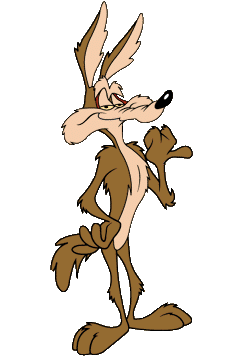
As he created the character Road Runner, the cartoon episodes for Road Runner, a set of rules were created....
 

...'The Rules'

1. The Road Runner cannot harm or upset the Coyote except by going 'MEEP! MEEP!'
 
2. No outside force can harm the Coyote, only his own clumsiness or the failure of his plans, plots and Acme Products.
 
3. The Coyote could stop anytime - if he were not a fanatic.
 
4. No dialogue is to ever be included other than 'MEEP! MEEP!'
 
5. The Road Runner must stay on the road otherwise there's no point in calling him Road Runner.
 
6. All action must be confined to the natural environment of the two characters, which is the Southwest American desert.
 
7. All materials, tools, weapons or mechanical conveniences must be obtained from Acne Corporation.
 
8. Whenever possible, make gravity the Coyote's greatest arch enemy.
 
9. The Coyote is always more humiliated than harmed by his failures.


Types of Thrillers

Types of Thrillers


There are many types and different variates of thriller sub-genres such as;
 
  • Psychological Thrillers
  • 

Some examples of films in these categories of sub-genre thrillers are:

Spy thrillers; Bond films, Bourne Legacy
Political thrillers; Machurian Candidate
Conspiracy thrillers; Taken
Legal thrillers; Pelican  Brief
Psychological thrillers; Psycho
Supernatural thrillers; Twilight saga

What can be associated with a Thriller?

Things that can be associated with a Thriller

 
There are many things that we relate and associate with thrillers, this is apart of mise-en-scene. Objects and things we associate with thrillers often has an effect on the audience. When we think of thrillers, we think of confined spaces, blood, shadows, darkness, loneliness and things that can make us scared and put us on edge.
 
Small Confined Spaces are usually related to Thrillers or horrors. Confined spaces help to have an effect on the audience members, it makes them feel as if they are trapped in a small space. Being trapped often leads to the person struggling to get out or breathing heavily, as they're in a stressed environment.
 
Weapons are one of the main objects identified in thrillers. But the main weapon used in thrillers that can be the harshest of all are knives. Being stabbed once or more times is brutal, painful and your suffering doesn't last a short while. Weapons immediately aware the audience that someone could die or get hurt, this grabs the audiences attention.
 
 Shadows have a big impact on how we feel during a film, it puts us on edge, it makes us tense and we fear for the victims life. Shadows and silhouettes create enigmas and brings about a mystery to the film and the killer.
 
 
 Street lamps lit up in the darkness have a big effect on the  audience as its light singles out a victim, and is likely to be what the killer sees or what the audience sees from a distance, this involves the audience a bit as they feel part of the film watching the victim.
 
The setting of a film can deliver the emotion of fear. When we see wide open desolate spaces we fear for the person wondering about on their own.
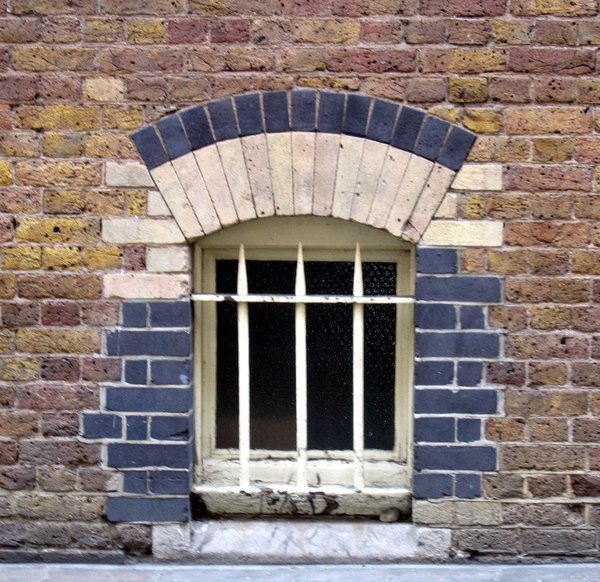
When we see bars on buildings and fences around a property, it makes us wonder and feel isolated and trapped and sorry for the victim inside. In some cases it could not be the victim inside, it could be the killer. In that circumstance we fear the killer.


Sounds such as loud noises or no noise at all can be associated with thrillers. Loud noises can create panic whereas silence can create tension, suspense and mystery.
 
 
Big Cities can also be involved and related to thrillers. In a big city its hard to find a killer, so it becomes challenging. And settings for thrillers in cities can bring a familiarity to an audience.
 

Wednesday, 9 January 2013

Suspense & Shock

Suspense & Shock

 
Suspense and shock are different outcomes which is a result from something.

Building up to suspense allows the audience to question what could happen next, therefore suspense is a long lasting build up. For example picture the following scene in your head, there's a classroom full of students and a teacher. The camera reveals that there's a bomb under the table to the audience, the students and teacher are oblivious to this. This therefore creates questions will the students and teacher be saved? Will the bomb go off?

So in a film you can be shocked by something, this emotion is quick and not long lasting. For example imagine the same scenario as the suspense example, where there are children in a classroom with their teacher, instead of the camera revealing the bomb under the table, it explodes without warning, killing everyone, the audience are then shocked by the outcome.


The 1936 film, Sabotage, by Alfred Hitchcock displays an understanding of suspense. A young boy is told to deliever a package to a certain place (a train station), by a certain time. He is oblivious that the package holds a bomb within. The boy's journey creates a build up of tension and suspense, as the audience knows more than what the young boy knows. Questions are created such as; Will the boy arrive at the train station on time? Will the boy die?

Other films by Hitchcock that created suspense in thrillers were 'The 39 Steps (1935)' and 'Northby North west (1959)'

Sunday, 6 January 2013

Film Language

Film Language

 
Films use many techniques to exaggerate and emphasise scenes and just to make a great film. they are:
  • Sound
  • Lighting
  • Cinematography
  • Mise en Scene
  • Pace and editing

Sound consists of things like:
  • Music
  • Dialogue
  • Silence
  • Sound effects
  • Real sound

Lighting consists of things like:
  • Key light
  • Fill light
  • Back light
  • Under lighting
  • Top lighting
  • Back lighting
  • Low key lighting
  • High key lighting

Cinematography consists of things like:
  • The look of the film
  • Types of shots
  • Colours- (Denotation: What you see, Connotation: What you think of)
  • Lighting
  • Locations

Mise en Scene consists of things like:
  • What you see in a frame on screen
  • The characters/acting
  • Props
  • Wardrobe/Clothing
  • Environmental details/Setting
  • Placement of everything on screen and stage
  • Effect on the audience

Pace and editing consists of:
  • Speed of action
  • Length of shots
Editing  is the process of looking at all the footage shot during the making of a film/ TV programme and placing it in the desired order and joining it together. There are two key areas they are:
1. Speed of Editing (how long each shot lasts for)
2. Style of Editing (how each shot is joined to the next)

In a film each scene may last a matter of seconds, or it could continue for minutes but the length of each sequence establishes the pace of the film moving the action along. Speed editing helps set out the mood of what is happening on screen. "Suspension of disbelief". If a relaxed mood is desired, the scenes last longer and change less frequently. For example in a romantic comedy. Scenes at the beginning of a film must be long, probably introduces the main character. As films progress, scenes may become shorter as editing cuts between telling two or more story lines simultaneously.

The word Complement is used when two or more things go together.
The word Juxtapose/Juxtaposition is used when something don't fit or go together.

Time Laps is when time speeds up to show how fast time is or time going by.


Graphic Match is when one image crosses and fades into another image for example, in psycho when the plug hole turns into the women's eye.

Straight cut is a more common and "invisible" form of transition. One shot moves instantaneously to the next without attracting the audiences attention. They help retain reality. They do not break the viewers suspension of disbelief.

Jump cut  is when the audience's attention is brought into focus on something very suddenly. It breaks continually and appears as if a section of the sequence has been removed.

A dissolve is when one image/scene merges or fades into another image/scene.

Fades are when an image/scene gradually darkens or lightens until it becomes black or white. One shot will fade until only a black or white screen can be seen.

Wipes are when one image is pushed off the screen by another, or by an object. Images can be pushed left or right so its natural, like reading a book.

Match on action is when we see a character start an action in one shot and then see them continue it in the next.

The 180 degrees rule is a basic guideline to help film action. It states that two characters in the scene should always have the same left/right realtionship to eachother.

Eyeline match is self explanatory, for example in frame 1 we see Person A looking straight forwards, then in frame 2 we see Person B looking straight forwards, therefore it looks like they're looking at eachother.

Shot/Reverse shot is when one frame is shot reasonably close to fit the persons face and the other persons shoulder in the frame. Then it is reversed to show the other persons face and the person they're talking to shoulder. Then it's reversed again, however many times that are desired.


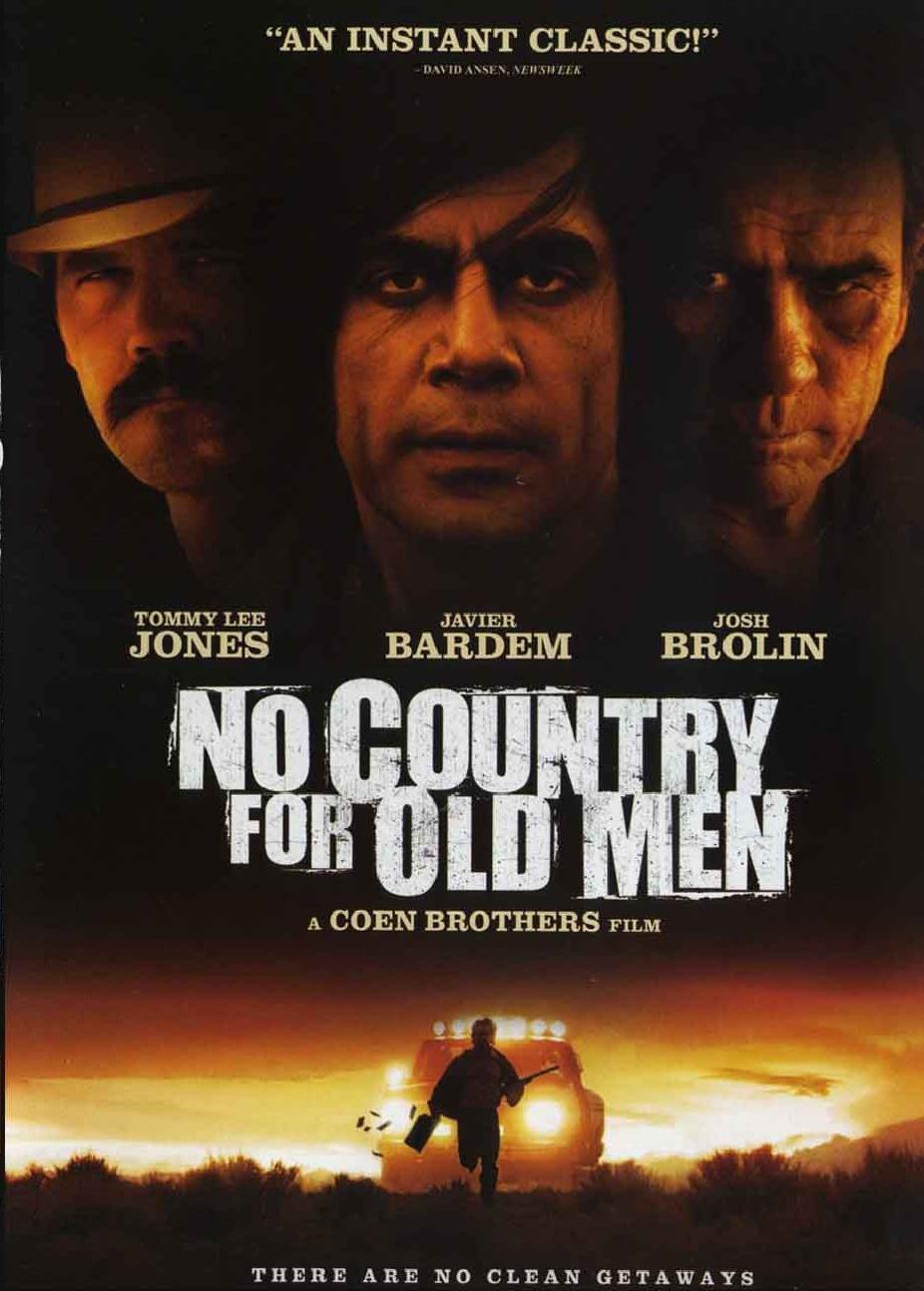
No Country for Old Men

No Country for Old Men


The genres of this film are Crime and Thriller.

In Texas, a hunter, Llewelyn Moss comes accross a drug deal gone wrong. Moss takes the drug deal money, which is two million dollars for himself. A psychopathic killer, Anton Chigurh goes after Moss for the money. Even though the hunter tried to keep one step in front of his killer, the killer was not one to give up until the job was done and the people were killed.

Tension is built up mass amounts throughout the film because someone is getting chased, and the killer was closing in on Moss, which creates suspense and causes the audience to be on the edge of their seats.

Directors:
Ethan Coen
Joel Coen

Writers:
Joel Coen (screenplay)
Ethan Coen (screenplay)
Cormac McCarthy (novel)

Cast:
Tommy Lee Jones as Ed Tom Bell
Javier Bardem as Anton Chigurh
Josh Brolin as Llewelyn Moss
Woody Harrelson as Carson Wells
Kelly Macdonald as Carla Jean Moss

Facts:
This film was made and created in the USA
No Country for Old men was released in the UK on the 18th January 2008
The estimated amount of money that would be made in the Box Office was $25,000,000
The films running time is 122 minutes
Paramount Vantage was the production company used to help produce this film


Friday, 4 January 2013

The Machurian Candidate (2004)

The Manchurian Candidate (2004)

 
The genres of this film is Thriller, Mystery and a Drama.


This film is a re-made modern version of the 1962 film, The Manchurian Candidate.

As stated in my former post on the 1962 Manchurian Candidate film it is about a former Korean war captain, Major Ben Marco and his sergeant, Raymond Shaw. Major Ben Marco was a intelligence officer for the United Stated army. Major Ben Marco, Raymond Shaw and the other members of their squad are all brainwashed by communists. Raymond Shaw is brainwashed into becoming a political assassin. But Major Ben Marco may find a way to save him.


Director:
Jonathan Demme

Writers:
Richard Condon (novel)
George Axelrod (1962 screenplay)
Daniel Payne (screenplay)
Dean Georgaris (screenplay)

Cast:
Denzel Washington as Major Ben Marco
Liev Schreiber as Raymond Shaw
Meryl Streep as Mrs. Eleanor Shaw
Vera Farmiga as Jocelyne Jordan
Jon Voight as Senator Thomas Jordan
Kimberly Elise as Rosie

Facts:
The film was made in America
It was released in the UK on the 19th November 2004
The estimated amount of money that would be made in the Box Office is $80,000,000
The films running time is 129 minutes
Unlike the 1962 version, this version is in colour
Paramount Pictures was one of the production companies used